English Lamp Posts Top Victorian Blog Award Winner 2011

Brought to you by English Lamp Posts

Thursday, April 22, 2010

Merlin and Vivien

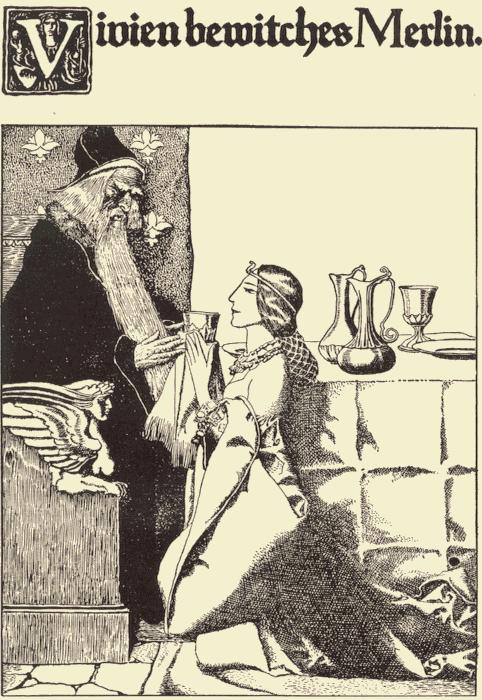
Vivien slithers her way into Arthur's court with a sob story about a seduction and manages to sow seeds of doubt about Guinevere.  She is successful in creating discord until she tries to entice Arthur, which fails miserably and makes her a subject of ridicule, forcing her to leave the Court.  Nevertheless, Vivien sets her eyes on Merlin, from whom she wishes to obtain a secret charm.  Merlin refuses, but Vivien wears him down until he relinquishes the secret and she uses the charm on him, leaving him "lost to life and use and name and fame.

Tennyson fashions Vivien in the mold of Delilah.  She begins by praising  him:  "Trample me/Dear feet, that I have followed through the world/And I will pay you worship."  She then requests his love:  "'O Merlin, do ye love me?' and again/'O Merlin, do ye love me?' and once more/'Great Master, do ye love me?'"  Then she tells him how he can prove his love: 

O Merlin, teach it me.
The charm so taught will charm us both to rest.
For, grant me some slight power upon your fate,
I, feeling that you felt me worthy trust,
Should rest and let you rest, knowing you mine.

Tennyson achieves this portrait by giving her serpentine qualities:
 
                                                    a robe
Of samite without price, that more exprest
Than hid her, clung about her lissome limbs,
In colour like the satin-shining palm
On sallows in the windy gleams of March.

The repeated use of the letter s adds a hissing sound for full effect.  Once he is in her grasp, she will not let go until she has squeeze the secret from him:

And lissome Vivien, holding by his heel,
Writhed toward him, slided up his knee and sat,
Behind his ankle twined her hollow feet
Together, curved an arm about his neck,
Clung like a snake;

And she evens goes so far as to wrap herself in his beard:

                              then adding all at once,
'And lo, I clothe myself with wisdom,' drew
The vast and shaggy mantle of his beard
Across her neck and bosom to her knee

Finally, Merlin wearies of her and tells her the secret:
 
The snake of gold slid from her hair, the braid
Slipt and uncoiled itself, she wept afresh,
And the dark wood grew darker toward the storm
In silence, while his anger slowly died
Within him, till he let his wisdom go
For ease of heart, and half believed her true

She in turn uses the secret charm against him and Merlin's powers no longer reside with him:

Then, in one moment, she put forth the charm
Of woven paces and of waving hands,
And in the hollow oak he lay as dead,
And lost to life and use and name and fame.

Then crying 'I have made his glory mine,'
And shrieking out 'O fool!' the harlot leapt
Adown the forest, and the thicket closed
Behind her, and the forest echoed 'fool.'

Vivien has achieved her goal and has made the wizard ineffectual.

The above depiction was extracted from http://www.candlelightstories.com/ .

Wednesday, April 21, 2010

Balin and Balan

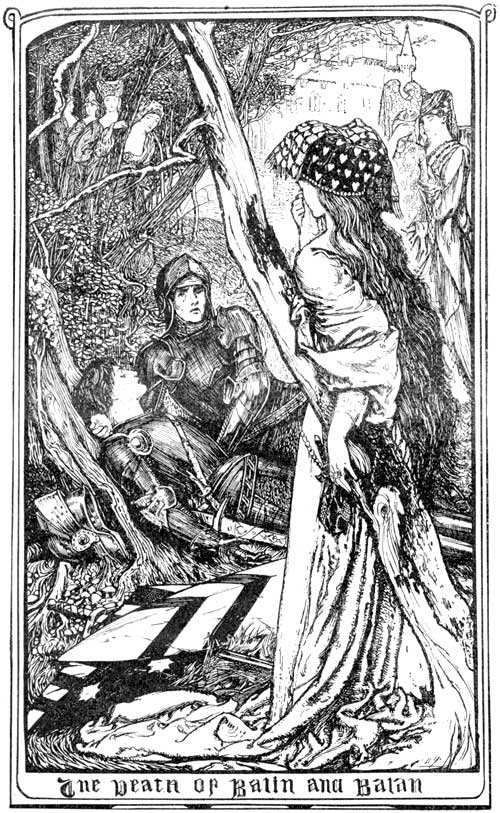
This idyll tells the story of twin brothers who are knights of Arthur's Round Table.  Arthur restores Balin's knighthood while Balan volunteers to kill the demon of the woods who has killed one of Arthur's knights.  Balin remains behind and develops true admiration for Guinevere and Lancelot before chancing upon them in the garden and seeing them talking about their supposed affair and does not want to believe it:  "Queen? subject? but I see not what I see./Damsel and lover? hear not what I hear."  He leaves the court to find his brother and hears of the rumor from Garlon, whom he fights, and the evil Vivien, who adds lies to his suspicions.  When Balan approaches Balin, he mistakes him for the woods demon and they kills one another.

This idylls contains much garden and forest imagery.  We first meet the brothers while they are sitting beside a fountain "from underneath a plume of lady fern."  When they return as knights at Arthur's court, they encounter a "woodland wealth/Of leaf, and gayest garlandage of flowers, along the walls and down the board."  In the woods dwells a demon who practices black magic.  Balin's temperament is described as "a flame/That rages in the woodland."  In the garden, "A walk of roses ran from door to door;/A walk of lilies crost it to the bower," and Balin sees Lancelot and Guinevere, who declares to the knight "we have ridden before among the flowers."  Balin, after he has fed from Garlon, finds himself unworthy of carrying a shield bearing the Queen's crown and hangs the shield on a branch in the woods, falls asleep in a glade, and is awakened by Vivien, who rides through the forest singing a song praising lust and plots to bring down Arthur and his knights.  She poisons Balin's mind with lies about Lancelot and Guinevere.  There in those woods, he and his brother Balan die.

The woods and the garden represent the weakness of the human flesh.  The garden is where Lancelot and Guinevere have met at least once before and where they carry on their relationship.  They place themselves outside in the open, a vulnerable position where they could be discovered easily.  Similarly, Balin subjects himself to vulnerability when he falls asleep in the woods.  He is at the mercy of nature and awakens to be tricked by Vivien.  Finally, just before dying, Balan states that the woods are where Vivien dwells and "dallies with (Garlon)."  The woods are where man gives in to the desires of the flesh and not a proper dwelling place for the knights of Arthur's Round Table.

The above drawing is The Death of Balin and Balin (1902) by H. J. Ford.

Monday, April 19, 2010

Geraint and Enid

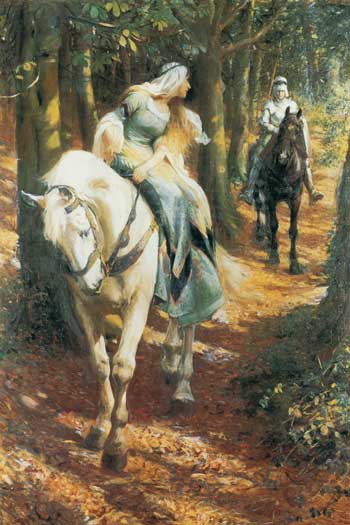
This section is made up of two idylls, both concerning the titular figures.  Geraint and his wife Enid are departing the court of King Arthur because of rumors about Queen Guinevere's "guilty love for Lancelot."  Geraint fears his wife will be subject to similar rumors, being so close to the Queen.  Tennyson flashes back to describe how they met:  Geraint,a knight of the Round Table, comes to the defense of Guinevere's honor after she is disrespected by Edryn.  Enid's beauty inspires him to defeat Edryn, causing him to ask for her hand.  After their marriage, the Queen keeps a promise to clothe the wife of Geraint.  Geraint tests his wife by forcing her to walk ahead of him and reamin silent.  Despite this, Enid repeatedly warns him of dangers ahead, proving her loyalty.

Tennyson's use of dramatic irony leads to a misunderstanding between husband and wife.  Geraint overhears his wife say, "I am no true wife," and the statement proves to be a double entendre to the couple.  He assumes that she has been unfaithful as is rumored about Guinevere though her real meaning is that she should tell her husband that people are ridiculing him.  Nevertheless, Enid proves herself faithful in the end.

The above painting is Enid and Geraint by Rowland Wheelwright (1870-1955).

Friday, April 16, 2010

Gareth and Lynette

Gareth is youngest son of Queen Bellicent and King Lot and desires to become one of Arthur's knights.  His mother objects but consents on the condition that he serve as a kitchen maid for a year and a day, a condition from which she releases him after a month.  Arthur makes Gareth a knight, telling no one but Lancelot, and when Lynette petitions to Arthur to send Lancelot to free her sister Lyonors from the confines of four knights, Arthur sends Gareth instead.  Lynette, thinking he is a kitchen maid, feels offended and scorns Gareth, but the latter is successful in his quest and rescues Lyonors.  Lynette appreciates Gareth's quest and marries him.

This idyll is similar to Pilgrim's Progress in that it is allegorical.  On entering the gate to the city, Gareth notices on the keystone a carving of the Lady of the Lake.  She has her arms stretched out like the cross, which represents the laying down of ones life.  Water drips from each hand, signifying a spiritual cleansing.  In one hand is a sword, showing there are spiritual battles ahead , and in the other hand is a censer, which represents the prayer needed for such a journey.  Lastly, "o'ver her breast floated the sacred fish," the fish being an ancient representation of Jesus, symbolizing salvation.  Gareth proceeds on his journey having a idea of what the journey has in store.

The first knight that opposes Gareth in his quest is Morning Star, whose blue armor and blue shield exude overconfidence.  He stands gloriously just before the battle and begins mocking Gareth, saying:

'A kitchen-knave, and sent in scorn of me!
Such fight not I, but answer scorn with scorn.
For this were shame to do him further wrong
Than set him on his feet, and take his horse
And arms, and so return him to the King.
Come, therefore, leave thy lady lightly, knave.
Avoid: for it beseemeth not a knave
To ride with such a lady.'

Gareth proceeds to defeat soundly the knight, who represents Pride, and sends him to Arthur to seek pardon.
 
The second foe is Noonday Sun, who rides a red horse and wears blindingly bright armor.  He has a red face of "rounded foolishness."  The two meet at midstream and fight to a draw until the horse of the Sun slips in the water and the Sun is "wash'd away."  To the king Gareth also sends this defeated foe.  The Sun represents Ambition; the bright red showing it to be a deep passion, which Tennyson calls foolishness.  The stream serves as a cleansing.  Gareth has defeated Pride and Ambition. 
 
The third knight is Evening Star, which represents Obstinacy.  This old foe has old and tarnished armor and seems to be "one that all in later, sadder age begins to war against ill uses of a life."  He has refused to change his ways, even to the detriment of his health.  However, he is also a more difficult foe to defeat in that he keeps getting up after getting knocked down.

But up like fire he started: and as oft
As Gareth brought him grovelling on his knees,
So many a time he vaulted up again;

Neverthless, Gareth overcomes him with his persistence and throws him into the river.

Death is the final obstacle Gareth must overcome.  Everything about this knight and his residence, Castle Perilous where Lady Lyonors is being imprisoned, is black.  Gareth sees the knight

Through those black foldings, that which housed therein.
High on a nightblack horse, in nightblack arms,
With white breast-bone, and barren ribs of Death,
And crowned with fleshless laughter.

Like his other quests, Gareth refuses to back down.  He knocks the knight off his horse and uses his sword to split open the skull.  Out came a young boy who states his brothers forced him to hold the Lady Lyonors captive.  Gareth demonstrated no fear and defeated Death, which no longer a ghastly monster but now only a young boy.  Gareth has proven himself as a knight and is worthy of Lynette's hand.

The above painting is The Overcoming of the Rusty Knight (1894-1908) by Arthur Hughes.

Wednesday, April 14, 2010

The Coming of Arthur

Idylls of the King opens with the section "The Coming of Arthur," which details Arthur's marriage to Guinevere.  King Leodogran of Cameliard summons Arthur to help him restore the wasted land, overrun by beasts and heathens.  Arthur consents and, upon arriving, sees Leodogran's daughter Guinevere and immediately falls in love.  After driving out the heathen and restoring order, Arthur sends three knights to ask for Guinevere's hand.  Leodogran withholds his consent, questioning whether Arthur is Uther's true son and, therefore, a legitimate king.  There is no consensus on the story behind Arthur's birth, so he decides to sleep on it and during this sleep, he has a dream which gives him confidence in Arthur's legitimacy; thus he agrees to give Guinevere to Arthur and Lancelot delivers to the King his new bride.

The dream scene illustrates the difficulty the king faces in making his decision. Introduced by the line, "Doubted, and drowsed, nodded and slept, and saw," the dream, through the unusual grammar, creates an uneasy mood.  The alliterative d sound allows the reader to feel the doubt that Leodogran experiences while the soothing s sound eases the doubt.  Leodogran sees a land that is growing uncontrollably until a "phantom king" appears in a cloud of smoke, representing the question of his birth, "[n]ow looming, and now lost," with the l sound illustrating the elusive nature of the king .  Suddenly, a sword appears and, while there are those that doubt Arthur's being Uther's son,

With a wink his dream was changed, the haze descended,
and the solid earth became
as nothing, but the King stood out in heaven,
Crown'd.

The haze is gone, and there is no longer any uncertainty concerning Arthur's birth, as he stands crowned in heaven.  Tennyson places a messianic mantle on Arthur as one chosen to restore order, faith, and purity to a land that had been seized by the heathen.

The above painting is King Arthur by Frank Dicksee (1853-1928).

LinkWithin

Related Posts with Thumbnails